AlbertFondaFarm_MohawkNY1859
Back Row: Douw Henry and Ann (Veeder) Fonda
Middle Row: Annetje, Alida and Sara
Front Row: Selena, Hester, Abraham, Albert and Henry
(see Fonda Stories)
AlbertFondaFarm_MohawkNY1962
The Albert Fonda Farm, originally 233 acres on Fonda-Johnstown Road (Rt. 30A), 1 mi. NW of Fonda, was occupied by several Fonda generations, ending with Albert Dow Fondas death in 1962; Douw Henry Fonda (1809-95) soon after his marriage (1832) to Ann Veeder (1810-90), daughter of Albert Veeder, son of Col. Abraham Veeder, took up residence in the small stone house then standing on the farm willed to him by his father, becoming the third successive owner since his patentee great grandfather, Douw Fonda "The Patriot" to whom it had been granted in 1748. His family grew rapidly and the stone house became the foundation of the second home, a frame structure which Douw and Ann began to replace by a still larger one in 1848, which was completed in 1856. All the timbers used in the building on this farm except those used in the four-story laying-house, built in 1935, and in the remodeling of the homestead, in 1936, came from trees grown there; all the foundation stones were gathered in the fields, except those cut from the limestone outcrop at Stone Arabia. These were hauled to the Fonda Farm on home-made wagons drawn by teams of oxen and were loaded and unloaded manually. The huge stones forming the front porch and the smaller ones in the wall along the highway were secured in the same area. All the first fences were of stone gathered in the fields and carefully piled, one upon another to a height of about three feet! Trees were cut and stumps were removed by hand; seed was planted; crops were harvested by hand and stored without the aid of machines. It was during the earliest years of Douw Henrys grandchildren that machines began to replace the endless back breaking hours of labor on farms in the Mohawk Valley. When, in 1848, the present farm home was begun, the first frame house was moved to a site, south, and became "The Tenant House;" it was burned during the summer of 1898, and replaced before the fall. On September 13, 1833, Douw Henry Fonda was appointed a "Sergeant," under the command of Daniel Moore, in the 34th Regiment, 11th Brigade, 14th Division of the NY State Militia. As such he served seven years. He was exempted from military duty on November 10, 1840; his Certification was signed by his older brother, Brigadier-General Peter Henry Fonda (1802-1874); In 1852, when the Fonda-Johnston Road became a two-lane highway (one lane plank, and the other dirt) Douw Henry lost the sight of his left eye by the same dynamite blast which killed his brother Adam, and which widened the roadbed through the slate outcrop between his home and the lands south of it. The present road was built on the former during 1910 and 1911.
BattleOfOriskany_1777
"Blood Shed a Stream Running Down" (General Herkimer lays mortally wounded...)
The Battle of Oriskany (between Utica and Rome, New York) was a key engagement in the American Revolutionary War. On August 6, 1777 an American militia force led by General Nicholas Herkimer was ambushed and routed by Barry St. Ledgers expeditionary force. In addition to the British regulars, a large Indian contingent under Joseph Brandt and John Butler participated in the ambush. The American force was on the march to relieve St. Ledgers siege of Fort Stanwix, but was repelled. Herkimer fell mortally wounded, but managed to rally his men to achieve an orderly withdrawal. A thunder storm provided the surviving Americans the chance to escape, but half of their force was dead, wounded or captured. Captain Jelles Douw Fonda led a company in the battle, which included his younger brother John Douw Fonda; both survived the fight.
The British had sent the expedition to join with General Burgoyne by way of the Mohawk Valley. However, the battle at Oriskany forced them to retreat. Nonetheless, Burgoyne pushed south to Stillwater, where he was defeated by Gates improvised army of continentals and militia in two battles: the 19th of September (Freemans Farm) and the 7th of October (Bemis Heights). On the 17th of October he was soundly defeated and was forced to surrender the entire British Army (Battle of Saratoga). This was followed by the alliance between America and France in 1778, and later by the addition of Spain to Englands enemies on June 21, 1779 -- events of far-reaching importance. View National Park Service Site
BirdsEyeView_FondaNY
(Image from the webpage Old Postcards of Fonda, NY)
CentralMohawkHistoricMap
An Historical Map of the Central Mohawk Valley
Drawn by John C. Devendorf - 1967
View map at FortKlock.com
DewittClintonFonda_1869-1947
Bottling Works Proprietor; b. Augusta, Hancock, Illinois
1880 & 1930 Census, Boulder, Colorado
bur. Green Mountain Cemetery, Boulder, Colorado
DouwJellisFonda House1781
Douw "The Patriot" Fonda, namesake of the Village of Fonda, NY; b. Schenectady, NY; moved to Caughnawaga (now Fonda) in 1751; killed by Sir John Johnsons Indians in 1780 and his house was plundered & burned; this house, in the center of town (Cayaduta Street), was being built at the time. It was completed after his death (1781) and occupied by son John and family. (see Fonda Stories)
Fonda-Johnst-Glover_Boxcar
Photo courtesy Gino DiCarlos (C) 2004The F.J. & G. was a short line Railroad that ran through Fulton and Montgomery Counties of Upstate New York. In its prime, the Railroad ran from Fonda to Northville, and its trolley line connected Gloversville to Amsterdam and Schenectady. The railroad has been gone since 1984, but you can take a course through its history at F. J. & G.s Virtual Museum.
(above inscription) This monument erected 1996 marks the site of the Gloversville Passenger Station and Main Offices of the Fonda, Johnstown and Gloversville Railroad. It is dedicated to those who migrated here with their skills and to all those who labored in the glove industry, upon which this city was built and for which it is named. Many received their first glimpse of their new home from this site. May their spirit of hard work, craftsmanship, self-reliance and dedication to family remain forever alive in all of us.
Fonda-Johnst-Glover_Locomotive
The Fonda, Johnstown and Gloversville Railroad company was organized on the 16th day of June, 1867, and was to be built mainly by bonds on the town of Johnstown, for $275,600. The line was ready and trains started on the 29th of November, 1870. The FJ&G was one of the first shortline railroads in the nation to dieselize. The first diesel to operate on the FJ&G was in the Spring of 1945. Later that year, in September of 1945, the FJ&Gs own first diesel arrived on the property. These two engines were the mainstay power on the line after their arrival. The FJG officially ceased operation in May of 1984. The official last freight run was in November of that same year.
FondaAve_BattleCreekMI
Fonda Ave., Battle Creek, MI - 1940
(Image from the webpage Battle Creek History)
FondaCoatOfArms
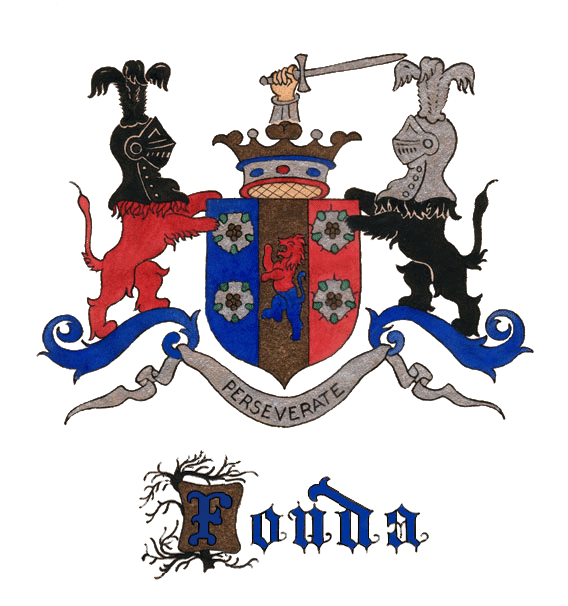
The arms are, per pale Azure and Gules, on a pale Or, between four heraldic roses. Argent, Seeded Or and Barbed Vert, a lion rampant per fesse of the second and first. Crest, out of a Marquis Coronet, an armed arm, the hand holding a sword, all proper. Supporters, on the dexter side, a Lion. Gules, having on a helmet surmounted with a plume of three ostrich feathers, sable, and on the sinister side a Lion Sable, with helmet and plume of the Ostrich feathers argent. The lion, in the coat of arms, signifies that the ancestor to whom it was granted, was commander in a victorious engagement with an enemy. The coronet, in the crest, denotes the rank he held. The arm, in tire armor, indicates that he had overcome a foreign Knight, by the sword. The plumed helmets, on the Supporters, being the badge of the principality of Pistoja, now a part of Tuscany, Italy. The inference is the victory was gained against that place. It Is about 100 mi. S. E. of Genoa. (this graphic was produced for Cornelia Dockstader Fonda in about 1940 by Mr. Short, Johnstown Jr High art teacher, who made it from available graphics and heraldic descriptions.) View Coat of Arms Transparent Image
FondaNY_HotelRoy
Built in 1835, Fondas grandest accomodations were at the Hotel Roy, which stood beside the train depot until a fire in 1905. Fonda station was a portal to the Adirondack region to the north for travelling men and glove buyers en route to the mills in Gloversville. (Image from the webpage Old Postcards of Fonda, NY)
FondaNY_Lithograph1889
drawn and published by L.R. Burleigh
View map at American Memory
FondaNY_MohawkRiverBridge
The twin villages of Fonda - Fultonville are on opposite sides of the Mohawk River and are connected by the bridge on NY Route 30A. Fondas on the north bank and Fultonvilles on the south. Straddling the major roads and railroads in the Mohawk Valley, these arent pretty tourist villages but working towns. But they have their charms and colonial history. (Image from the webpage Old Postcards of Fonda, NY)
FondaNY_MohawkValley
(Image from the webpage Old Postcards of Fonda, NY)
FondaNY_MontCoCourthouse
With the formation of Tyron County from Albany in 1772, Johnstown was named the county seat. Construction of a courthouse commenced immediately. Tryon County in 1784 changed its name to Montgomery in honor of Revolutionary War Gen. Richard Montgomery killed attempting to take Canada. The county seat remained Johnstown. This vast county eventually subdivided into other counties with new county seats. New modes and routes of travel eventually isolated Montgomerys old county seat at Johnstown.
In 1836 the county seat was moved south to Fonda. In December 1837, the Johnstown courthouse and jail were sold at public auction. But residents in the northern part of the county wished to keep Johnstown as their county seat. In 1838 they formed a new county, named it for steamboater Robert Fulton, restored Johnstown to county seat status, and repurchased the courthouse and jail.
The Montgomery County Department of History and Archives, a valuable source of information for genealogy research, is housed in the Montgomery County Courthouse, which is constructed in Grecian Revival architecture. The Montgomery County Chamber of Commerce is located in nearby Amsterdam.
FondaNY_RailStation
The Village of Fonda is bisected by the four pairs of rails that once carried the New York Centrals Great Steel Fleet through the Mohawk Valley. But today even the Utica local is extinct. The little stone station was torn down in 1964. The trolley was replaced by bus service in 1932. But one reminder of the days when Main Street Fonda was the local commercial hub are several intact "business blocks" (seen in the background). Reversing the usual trend, some of them have been converted to residential use. In spite of the unmatched window replacement, the Main Street block has retained its basic symmetry, each building sharing the same saw-toothed window line and arched cornice topped by a sheetmetal fleur-de-lis. (Image from the webpage Old Postcards of Fonda, NY)
FondaNY_RefDutchChurch
The Reformed Protestant Dutch Church of Caughnawaga, its title until 1867, when the term "Dutch" was dropped (Caughnawaga being changed to Fonda in 1872), was organized in 1758 by a Low Dutch element, the first building being erected of stone in 1763, to which was added a steeple in 1795. In the destruction of the village by the Johnsons in 1780 the church was about the only unburned building and this was due to the fact that it was built on the Butler estate land and was supposed to belong to the Butler family. Douw Fonda came into this area in 1751, and after him the village was named. When Fonda had come to his eightieth year, on May 22, 1780, he was killed at his home, and two of his sons, John and Adam, were taken captives to Canada. There is a story current that the renegade Tory, Walter Butler, killed the old man who had been a great friend of Sir William Johnson.
FondaNY_Tavern1781
Built about 1781 by John Fonda of the Tryon County Militia. A large pretentious building, where both passengers and teams found comfort and good cheer. John Fonda was a brother of Jellis, and a son of Douw Fonda, the founder of the village. (see Old Postcards of Fonda, NY)
FondaNY_TopogrMap1898
USGS digital topographic map
(latitude 42.952471º, longitude -74.372193º)
View map at TopoZone
FondaNY_Village1950
The village was named after Douw Fonda who came from Schenectady and settled there in 1751. The former name for the village of Fonda was "Caughnawaga", the meaning of which is "stone in the water" or "at the rapids." The Caughnawagas of Tribes Hill were a family of the Wolf Tribe of the Mohawks, to which tribe Brants mother belonged. In 1669 the Jesuits built a chapel here, called St. Peters of logs on the Sand Flats of Caughnawaga near Fonda. Here in 1676 the Iroquois maiden, Te-ga-wi-ta, the white lily of the Mohawk, the now canonized saint of the Romanists, was baptised by James de Lamberville. The town of Caughnawaga originally embraced all that part of Montgomery County lying north of the Mohawk and east of a line extending from the "Nose" to Canada. In 1793 it was divided into Amsterdam, Broadalbin, Johnstown and Mayfield. As early as 1659 Arent Van Curler held a conference with the Mohawks at Caughnawaga, renewing the treaty of 1643.
FondaOriginsMap_Italy
Fonda Italian name origins 1). so called from the Latin "fundus", meaning the bottom. Fondi, a town of Campania, Italy occupies the site of the ancient Fundi, a Voiscian town, belonging later to Latium Adjectum, on the Via Appia, still represented by the modern high-road which passes through the centre of the town. 2). may have originated from the town of Piran (first mentioned in year 1230 regarding Dominicus Fonda) on the NE coast of the Adriatic sea. Piran is now in Slovenia, and many Fondas today still live in nearby Trieste, Italy. 3). "The family name is taken from a deep valley in the Apennines, about 12 mi. from the city of Genoa, called Fonda, a name which means bottom, deep, foundation, etc. It is said that, in the early part of the last century, the estate was still in the possession of a branch of the family, the Count de Fonda, and there are many of the name, in the various parts of the Genoese territories. Some of the family may have known Columbus in Genoa."
FondaOriginsMap_Neth
The New York Genealogical and Biographical Record, "Amsterdam Records of the Fonda Family" states: In Frisian records van der Meer did not find any mention of the name Fonda, but in the vicinity of Kollum in northeast Friesland, where Benedictus Jacobs lived, he came across the names Banda, Ronda and Sinda. He also noted that in 1580, Benedictus was manager of an estate near Kollum called "Foyngha," and there was a chance that "Fonda" was a corruption of that name.
Geddes_Fonda_Farm_IL
Hancock County, Illinois home built in 1866 by Col. John Giles Fonda on land belonging to his father-in-law, James McConnell.
"As teenagers, wife Mary and sister Martha McConnell sent letters to kinfolk in PA about the loneliness and hardships of pioneer life. The stately marital home was guarded by a palisade of walnut trees. The dirt road was called Fonda Lane and it lead to the little village of Fountain Green about a mile away. This home was much later owned by my grandparents, Allen and Edna Geddes. The Geddes-McConnell Cemetery is within site of the farm. Except for Alexander Walker Geddes, who served under Col Fonda and is buried where he died on Champion Hill during the siege of Vicksburg, they all lie side by side in the black soil of that prairie place. Sadly the old farm has fallen into decay since my grandparents passed."
(by Barbara Shave, British Columbia, Canada 8-Dec-2005)
GeorgeFarrellFonda_1858-1943
Fire Chief, Apothecary, Bank Vice President; Director Boulder Milling and Elevator Company
b. Augusta, Hancock, Illinois; 1880 & 1930 Census, Boulder, Colorado (see Fonda Stories)
GilesHFonda_DrugStore1880s
Retail Drug Merchant, Chemist; b. Warsaw, Hancock, Illinois; 1850 Census, Schuyler, Illinois; 1870 Census, Central City, Gilpin Co., Colorado; 1880 United States Census, Leadville, Lake Co., Colorado; d. Denver, Colorado; older brother of George Farrell Fonda and Dewitt Clinton Fonda. (see Fonda Stories)
JellisDouwFonda_House1790
The Jellis Fonda house, on the hill, was built in 1790. Following the war, the Major built this house on Montgomery Terrace in Fonda, overlooking the Valley from its sightly location; but unfortunately he never lived to occupy it. His home was where the County Fairground now is, doubtless a more or less temporary one on the site of the house destroyed by the raids in 1780, and there he was suddenly taken ill and died. His body was brought to the (still unfinished) mansion on the hill, and the burial took place from there (after boards had been laid down for floors). Following the funeral, his family occupied the new home.
The porch was added during the Greek Revival period (1820-1850s), by Washington Frothingham, a journalist and historian. He contributed important matter to our Mohawk Valley records and the public library in Fonda is named after him. Washington Frothingham died in 1918 at the age of 94 and this first house erected on the hill, which was the Fonda Mansion, is now called the Frothingham House, and later, the Lasher House. (see Little Journeys Along the Old Mohawk Turnpike)
JellisDouwFonda_Letter1786
...to the same Gerrit by the Court here of his account alledged, and the same Philip and Mary A. Judgment conferred and figured before me the 4th Day of March 1786. Jellis Fonda Judge.
JellisDouwFonda_PowderHorn1767
The Jellis Fonda Horn. Jellis Fonda. 1727-1791. One of the prominent men of Old Tryon County. Indian Trader at Caughnawaga. A Captain in French & Indian War in campaigns against Canada. While the horn contains the dates 1751 and 1756, it probably was not made until after he became a member of St. Patricks Lodge of Masons, March 7, 1767. Captain Fonda & his company of Mohawk Valley men, under Sir Wm. Johnson during the French & Indian War, assisted in repairing & building the defences at Lake George, which is recorded on his Powder Horn. Owner, E. Corning Davis. Fonda, N.Y. R.M.Hartley 2-27-1937.
MohawkValleyWatershed
The Mohawk River is a major waterway in northwestern New York. The river flows about 150 miles ESE from Oneida County entering the Hudson River near Albany. The cities of Schenectady, Amsterdam, Utica, and Rome are built on its banks. The river and its supporting canal, the New York State Barge Canal (still referred to as the Erie Canal), connect the Hudson River and port of New York with the Great Lakes. The river has long been important to transportation and migration to the west as a passage between the Allegheny and Adirondack highlands. The fertile valley also attracted early settlers, and a number of important battles of the French and Indian War and the Revolution were fought here. During the early westward growth of the United States, the Erie Canal was an important link to the west that followed or used the rivers path.
MontgomeryCountyNYMap_1848
Montgomery County was formed from Albany County in 1772 (as Tryon County), and at that time covered a large part of the state. The name was changed to Montgomery in 1784 in honor of General Richard Montgomery, Revolutionary War hero. Thirty-four counties were formed from the original Tryon-Montgomery County.
SchenectadyMassacre_1690
Douw Jellis Fonda, born 1700 in Schenectady, married Maritje, daughter of the heroic Adam Vrooman, survivor of the Schenectady Indian Massacre in 1690. An attack by the French and their Indian allies on the Dutch and English settlement at Schenectady in New York on February 8 and 9, 1690. The attack came in retaliation for a series of devastating Iroquois raids on Canada, which had essentially stopped the French fur trade for two years. The raid was an attempt to punish the English for supplying arms and ammunition to the Iroquois and to bolster the morale of the French Canadians and western tribes with an easy victory since the Iroquois were impossible to defeat.
Approximately 60 people were killed in the raid on Schenectady (including 10 women and 12 children) and between 80 and 90 were taken prisoner. The Schenectady raid was part of a three-pronged French attack on isolated northern and western settlements. The two other prongs of the attack were at Salmon Falls, New Hampshire, where 30 were killed and 54 prisoners were tortured to death and Fort Loyal (today, Portland, Maine), where the inhabitants were killed or taken prisoner. Overall, the raids convey a strong impression of cruelty on the part of the French and their allies and carelessness and greediness on the part of the English and Dutch.
Schoharie Crossing Erie Canal
Completed in 1825, the Erie Canal followed the course of the Mohawk River in (then larger) Montgomery County. Its gap through the Appalachians at "the Noses" allowed the first commercially successful connection between Americas east and west. As one of the 19th centurys greatest engineering projects, the canal had a huge impact on the growth of New York State and the nation.
The Schoharie Aqueduct (5 miles E of Fonda-Fultonville, New York), a 624-foot, 14-arch aqueduct was built between 1839 and 1841 to carry the enlarged Erie Canal across the Schoharie Creek. Six arches of the aqueduct remain intact. Because the original 1820s Erie Canal entered the creek itself, whenever the Schoharie was flooding, traffic on the canal was often halted for days. After the aqueduct went into operation, canal traffic no longer had to be interrupted.
The aqueduct was abandoned in 1917, when the barge canal opened in the Mohawk River. It remained intact until the late 1930s or early 1940s, when two of the arches at its east end collapsed. Three or more arches were removed subsequently to allow for the ice jams to flow out of the Schoharie Creek. Montgomery County has seven locks on the Erie Canal, each with a park where tourists can stop and picnic along the river. The Erie Canal still operates for navigation from early May to late November.
xHenryFonda_Birthplace
Herberta Jaynes Fonda with newborn son Henry in 1905, Grand Island, Hall Co., Nebraska; Henrys grandfather Ten Eyck Hilton Fonda moved his family from Illinois to Nebraska in 1878 for railroad work Henrys acting debut was with the Omaha Community Playhouse, a local amateur theater troupe directed by Dorothy Brando. He moved to the Cape Cod University Players and later Broadway, to expand his theatrical career from 1926 to 1934. His first major roles in Broadway include "New Faces of America" and "The Farmer Takes a Wife". The latter play was transferred to the screen in 1935 and became the start-up of Fondas lifelong Hollywood career.